











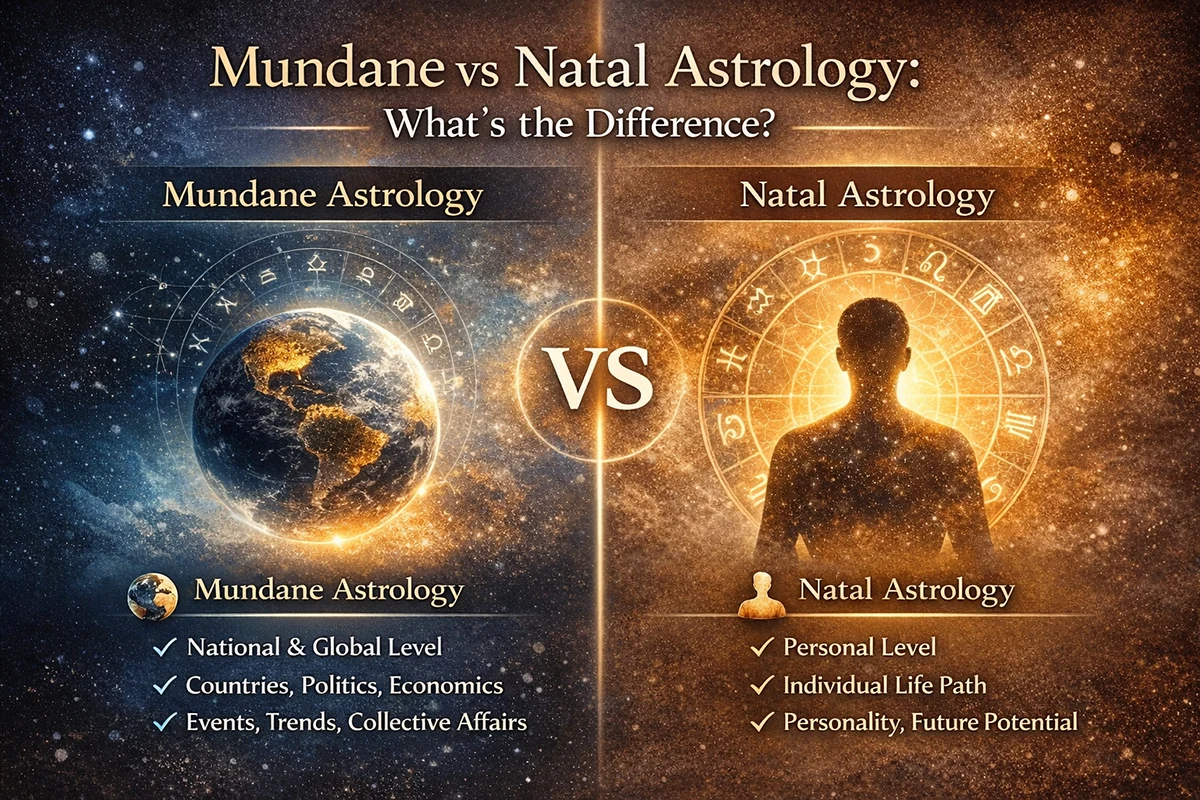
Mundane astrology stands as one of the most ancient and profound branches of astrological study. Unlike personal or natal astrology, which centers on an individual’s life path, personality, and experiences, mundane astrology examines broader forces shaping societies, countries, governments, economies, and worldwide developments. It explores political shifts, financial fluctuations, social movements, international relations, and large-scale events that influence entire populations.
This discipline operates on a collective level, revealing how celestial cycles affect the “macro” picture of human civilization. By analyzing planetary movements and specific charts for nations or significant events, mundane astrologers gain insights into periods of stability, upheaval, prosperity, or crisis on a global or national scale. It helps us comprehend why certain eras bring innovation and reform while others trigger conflict or transformation.
How Mundane Astrology Connects to Everyday Lives
Even though mundane astrology focuses on large-scale phenomena, its effects ripple down to influence every person. National policies, economic conditions, international tensions, and societal changes directly impact our opportunities, security, and daily realities. We all exist within the larger context of our country and the world.
The planets Jupiter and Saturn play key guardian roles here. They act as bridges between our personal microcosm and the wider external world. A well-placed Jupiter might indicate easier adaptation to societal opportunities, while challenging positions in these planets can suggest difficulty detaching from national or global pressures, making individuals more vulnerable to collective moods and events.
In essence, mundane astrology reminds us that personal destinies are intertwined with the fate of communities and nations. Understanding these bigger patterns empowers people to navigate life’s challenges with greater awareness.
A Brief History of Mundane Astrology
Mundane astrology traces its roots back thousands of years, making it one of the oldest applications of celestial observation. Ancient civilizations, particularly in Mesopotamia, used sky patterns primarily to forecast weather, harvests, wars, and the fortunes of rulers and kingdoms rather than individual horoscopes.
Historically, astrologers relied heavily on mundane and horary techniques because they did not always require precise birth times. Early interpretations simplified matters to core symbols: the Sun often stood for the ruler or governing authority, while the Moon represented the general population and public sentiment. The ruler’s chart essentially served as a proxy for the entire realm, with events in the leader’s life mirroring the country’s trajectory.
Over centuries, as astrology evolved, mundane practice developed more sophisticated methods. Today, it incorporates dedicated national charts based on founding moments (such as independence declarations or constitution signings), alongside ongoing techniques like solar ingresses, eclipses, and planetary cycles. This evolution allows modern practitioners to interpret complex global flows with depth and nuance.
Key Planets in Mundane Astrology
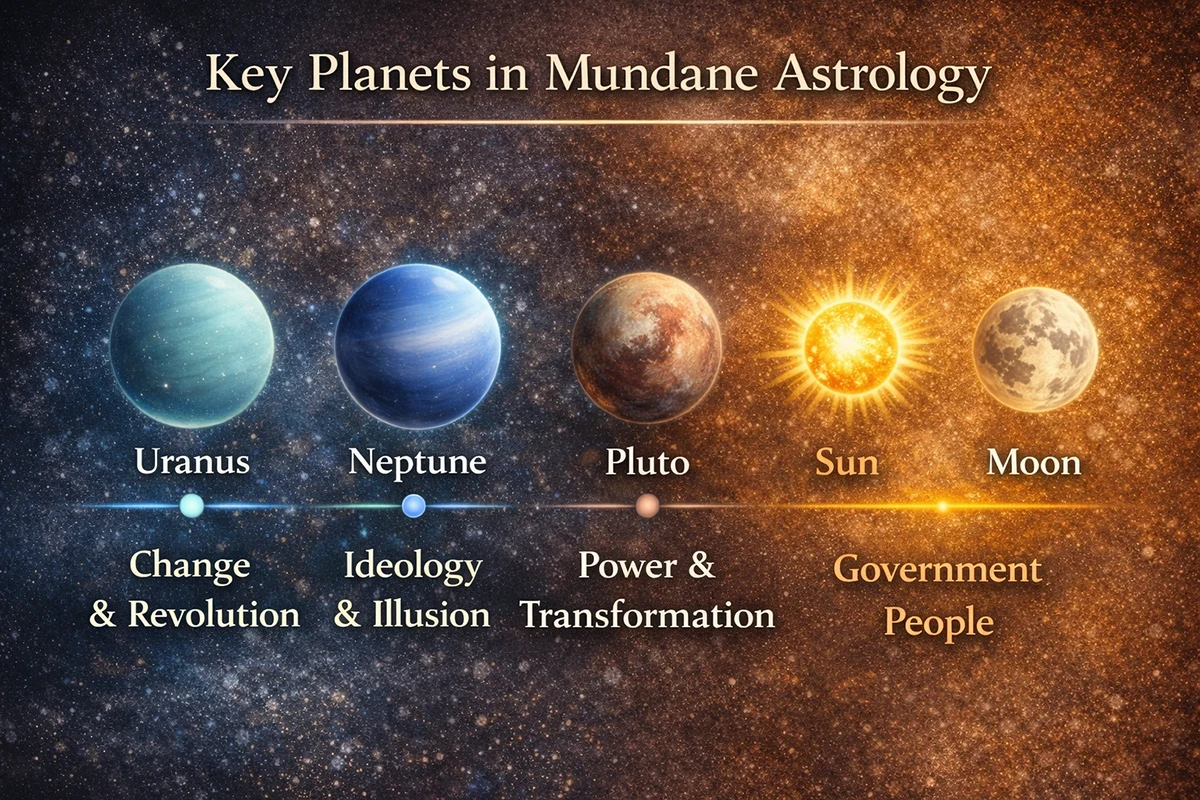
In mundane work, certain celestial bodies take center stage due to their symbolic and cyclical importance. While all planets contribute, the outer or transpersonal planets—Uranus, Neptune, and Pluto—hold particular significance. These slow-moving bodies generate long-term cycles that span decades or centuries, marking eras of revolutionary change, ideological shifts, and profound transformation.
Uranus brings sudden disruptions, innovation, rebellion, and technological breakthroughs, often linked to social upheavals or demands for freedom. Neptune dissolves boundaries, influencing collective ideals, spirituality, illusions, media, and sometimes confusion or scandals on a mass scale. Pluto intensifies power dynamics, exposing hidden truths, triggering crises, regeneration, and major shifts in control or resources.
Traditional planets also carry specialized meanings:
- The Sun symbolizes the government, leadership, authority figures, and the nation’s core identity or vitality.
- The Moon represents the people, public opinion, women, crowds, and emotional climate of a society.
- Mercury governs communication, media, education, trade, and intellectual discourse.
- Venus relates to diplomacy, arts, culture, social harmony, and financial prosperity.
- Mars rules military matters, conflicts, industry, and assertive national actions.
- Jupiter expands growth, justice, religion, international relations, and economic optimism.
- Saturn structures governance, law, restrictions, stability, and long-term challenges or responsibilities.
General planetary configurations in the sky can highlight worldwide themes, but each country has its own unique chart. Accurate founding data proves essential, though it sometimes requires cross-verification from multiple historical sources. Additionally, a leader’s personal chart often synchronizes with the nation’s, as the ruler embodies the state. A strong Moon in a leader’s chart, for instance, can signal better alignment with public needs and more stable popular support.
The Role of Houses in Mundane Charts
Houses in a national or mundane horoscope retain the familiar twelve-fold structure but carry adapted interpretations tailored to collective rather than personal affairs. They describe specific domains of national life and become activated through transits, aspects, or progressions.
Here are some key house meanings in mundane astrology:
- 1st House: The nation as a whole, its general condition, vitality, public image, and overall health or prosperity of the population.
- 2nd House: National economy, wealth, currency strength, banking system, revenues, trade, and financial resources.
- 3rd House: Transportation networks, communication systems, media, education, neighboring countries, and internal information flow.
- 4th House: Land, agriculture, natural resources, housing, weather patterns, and foundational stability or domestic policies.
- 5th House: Culture, arts, entertainment, sports, education systems, and matters related to children or national creativity.
- 6th House: Workforce, public health, labor conditions, military service, and daily administrative functions.
- 7th House: International relations, diplomacy, alliances, trade partners, and open conflicts or partnerships with other nations.
- 8th House: Shared resources, debts, taxes, crises, insurance, inheritance, and transformative events like financial reforms or losses.
- 9th House: Higher education, philosophy, religion, legal systems, foreign affairs, tourism, and national beliefs or ideology.
- 10th House: Government, leadership, reputation on the world stage, executive power, and national achievements or authority.
- 11th House: Allies, international organizations, social reforms, hopes for the future, and legislative bodies.
- 12th House: Hidden matters, secrets, institutions like prisons or hospitals, espionage, collective karma, and subconscious influences on society.
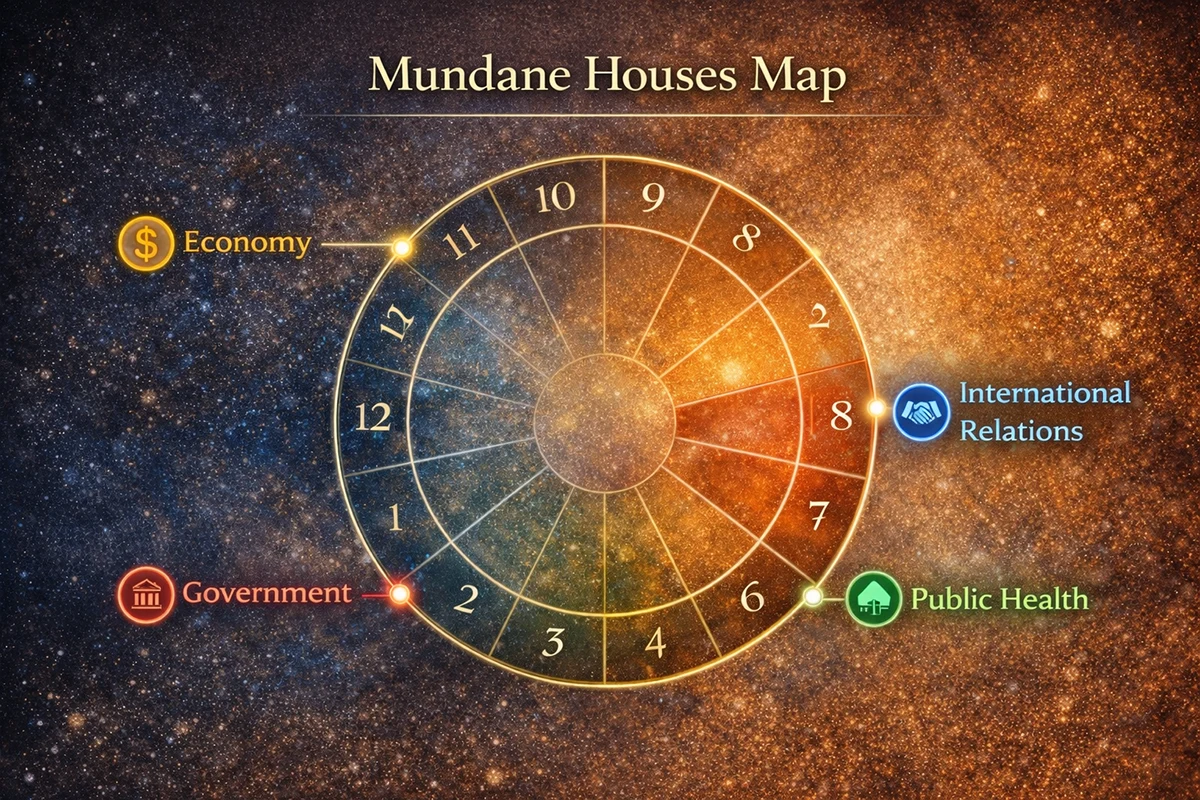
These house significations shift focus from individual concerns (such as personal short trips in the 3rd house) to broader equivalents like national infrastructure or media landscapes. Planetary placements and aspects within these houses reveal which areas of a country’s life will experience emphasis, tension, or opportunity during specific periods.
Practical Applications and Benefits of Mundane Astrology
Mundane astrology serves as a valuable tool for anticipating trends rather than rigid predictions. Astrologers examine techniques such as Aries ingresses (charts for the Sun entering Aries each year), eclipse effects, lunation charts, and major planetary conjunctions to forecast potential developments.
For individuals, studying mundane patterns fosters better preparedness—whether for economic shifts, political changes, or global events. It encourages informed decision-making, such as timing investments, understanding migration influences, or recognizing periods of collective healing and growth.
On a deeper level, this branch highlights humanity’s interconnectedness. Planetary cycles remind us that societies evolve through repeating rhythms of expansion and contraction, innovation and consolidation. By appreciating these cosmic tides, we gain perspective on current affairs and cultivate resilience amid uncertainty.
Whether you are a student of astrology, a curious observer of world events, or someone seeking context for turbulent times, mundane astrology offers a rich, layered framework. It bridges ancient wisdom with modern realities, helping us navigate the ever-changing landscape of nations and global life with insight and foresight.
Exploring this field deepens appreciation for astrology’s power to illuminate not just personal journeys but the grand story of human civilization itself.
